


Recent Changes to the Definition of Sexual Assault under Title IX
In June 2025 the Federal Bureau of Investigation’s (“FBI”) Uniform Crime Reporting Program (“UCR”) made updates that impact how educational institutions define “sexual assault” when processing matters in accordance with Title IX of the Education Amendments of 1972 (“Title IX”).
The 2020 Title IX Regulations cite to the Jeanne Clery Campus Safety Act (“Clery Act”)[1], which is a federal law requiring colleges and universities to disclose information about crime on and around their campuses, for the definition for “sexual assault.” The Clery Act in turn refers to the FBI’s definition in the UCR:
The term “sexual assault” means an offense classified as a forcible or nonforcible sex offense under the uniform crime reporting system of the Federal Bureau of Investigation.
Several years after the 2020 Title IX Regulations were released, the FBI published updates to the definitions of specific sex offenses in these referenced documents, which may leave institutions uncertain about which definitions currently apply to Title IX matters.
Key Changes to National Incident-Based Reporting System Definitions
The FBI’s UCR program has collected and published nationwide crime statistics since 1930.[2] These statistics were historically collected through a Summary Reporting System (“SRS”), but the FBI later transitioned to a new program called the National Incident-Based Reporting System (“NIBRS”).
According to § 106.30(a) of the 2020 Title IX Regulations, “sexual assault” is “defined in 20 U.S.C. 1092(f)(6)(A)(v).” This citation — a direct reference to the Clery Act — defines “sexual assault” as “an offense classified as a forcible or nonforcible sex offense under the uniform crime reporting system of the Federal Bureau of Investigation.” The Clery Act’s implementing regulations[3] further direct recipients of federal funding (“recipients” or “Districts”) to utilize the SRS’s definition of “rape” and the NIBRS’s definition of “fondling,” “statutory rape,” and “incest” as sex offenses falling under “sexual assault.”
NIBRS Definition Updates
The 2020 Title IX Regulations referenced definitions from the FBI’s 2019.2 version of the NIBRS User Manual, dated May 7, 2020, which included the following relevant definitions:
The 2019.2 NIBRS User Manual, released Fall 2020[4], defined “fondling” as follows:
The touching of the private body parts of another person[5] for the purpose of sexual gratification, without the consent of the victim, including instances where the victim is incapable of giving consent because of his/her age or because of his/her temporary or permanent mental or physical incapacity.
This version of the User Manual also removed references to “forcible” and “nonforcible” sex offenses.
On June 23, 2025, the FBI published the latest 2025 NIBRS User Manual which reflected further revisions to the definitions of sex offenses. Specifically, the term “fondling” changed to “criminal sexual contact,” and the updated definition is set forth below:
The intentional touching of the clothed or unclothed body parts without consent of the victim for the purpose of sexual degradation, sexual gratification, or sexual humiliation.
The forced touching by the victim of the actor’s clothed or unclothed body parts, without consent of the victim for the purpose of sexual degradation, sexual gratification, or sexual humiliation.
Although the definition no longer refers to “private” body parts, the examples given in the manual refer to “private areas” such as the breasts, groin, and buttocks. The updated definition also expands the definition of criminal sexual contact to include “instances where the victim is incapable of giving consent because of age or incapacity due to temporary or permanent mental or physical impairment or intoxication for the purpose of sexual degradation, sexual gratification, or sexual humiliation.”
Impact on Educational Institutions
Currently, the OCR has not provided guidance regarding which definitions of the NIBRS User Manual recipients should utilize under Title IX. However, our Title IX attorneys at AALRR recommend that recipients apply the new definition for complaints filed on or after June 25, 2025. For complaints filed prior to June 25, 2025, consult with legal counsel to discuss the best approach for your institution’s interpretation of the applicable definitions.
Because the NIBRS definition revisions impact the meaning of the operative language used in the 2020 Title IX Regulations, AALRR also recommends that educational institutions and other recipients bound by Title IX consult with legal counsel to discuss the change in the NIBRS definitions and how those changes may impact your institution’s policies.
Please contact AALRR if your institution needs training or assistance in complying with the 2020 Title IX Regulations or other state and federal laws prohibiting sex discrimination.
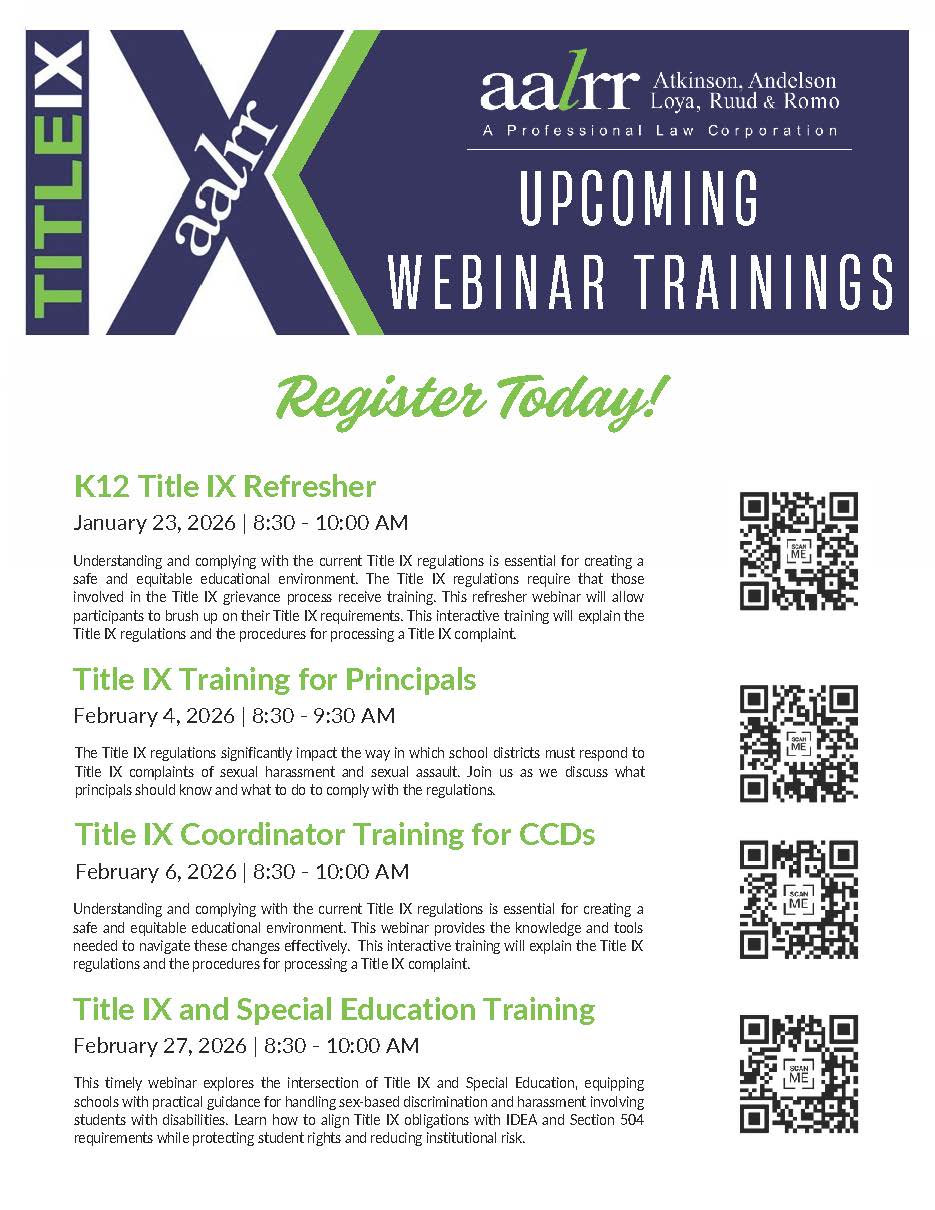
To assist you in your compliance efforts consider joining our Title IX Training Academy.
[1] See 20 U.S.C. 1092(f)(6)(A)(v).
[2] For more information about the history and evolution of the FBI’s UCR Program, visit: https://www.fbi.gov/how-we-can-help-you/more-fbi-services-and-information/ucr
[3] See 34 C.F.R. § 668.46(a) and (c)(9).
[4] See also the Change Description Summary chart from the current 2025.0 NIBRS User Manual, which notes updates to the NIBRS Offense Definitions made on May 4, 2020.
[5] According to guidance issued by the OCR in 2020, private body parts refers to buttocks, groin, and breasts. (See https://www.ed.gov/media/document/repository-open-titleix-answerspdf-33949.pdf.)
This AALRR publication is intended for informational purposes only and should not be relied upon in reaching a conclusion in a particular area of law. Applicability of the legal principles discussed may differ substantially in individual situations. Receipt of this or any other AALRR publication does not create an attorney-client relationship. The Firm is not responsible for inadvertent errors that may occur in the publishing process.
©2026 Atkinson, Andelson, Loya, Ruud & Romo
Attorneys
 Partner916-923-1200
 Associate562-653-3200
 Senior Associate916-923-1200
 Partner916-923-1200
 Partner562-653-3200